Yuri Semakov ( semakov@ukr.net )
SUPERLUMINAL COMMUNICATION
IN THE PHYSICAL VACUUM VIA LONGITUDINAL WAVES
THE
MODEL OF THE UNIVERSE AS A SPHERICAL RESONATOR AND THE CYCLE OF MATTER AT THE
PLANCK LIMIT
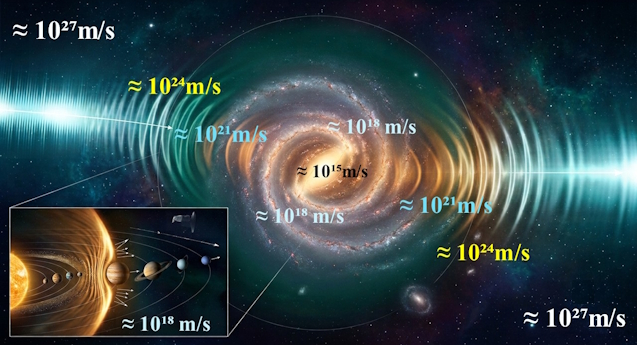 In the previous work, based on
the fundamental laws of physics, a calculation of propagation speeds of
longitudinal waves was performed in the range from 10²⁷ m/s at the
edge of the Universe to 10¹⁵ m/s in the core of the Milky Way
Galaxy.
In the previous work, based on
the fundamental laws of physics, a calculation of propagation speeds of
longitudinal waves was performed in the range from 10²⁷ m/s at the
edge of the Universe to 10¹⁵ m/s in the core of the Milky Way
Galaxy.
Possible local
deviations of speed in the cores of other galactic
systems only emphasize the dynamics of the process, without violating the
overall concept.
The change in
wavefront speed represents a regular process of "shedding and gaining
inertia" during its interaction with the matter of the Universe at all
levels of its hierarchical structure.
Having the value
of the absolute speed of a longitudinal wave in the intergalactic vacuum
(10²⁷ m/s), we can calculate the limiting geometric size of our
Universe and its fundamental resonance.
Fundamental constants (SI):
•
Quantum "death" threshold (m_min):
1.00000000 × 10⁻⁵⁴ kg
•
Longitudinal wave speed (v): 1.00000000 × 10²⁷ m/s
•
Speed of light in vacuum (c): 2.99792458 × 10⁸ m/s
•
Planck constant (h): 6.62607015 × 10⁻³⁴ J·s
•
1 light year (Julian ly): 9.46073047 ×
10¹⁵ m
Calculation of limiting energy
and frequency of the vacuum:
•
Energy equivalent of the critical mass of the quantum (E_min):
E_min = m_min × c²
E_min =
1.0 × 10⁻⁵⁴ kg × (2.99792458 × 10⁸
m/s)² = 8.987551787368176 × 10⁻³⁸ J
•
Exact fundamental frequency of this limit according to Planck (f_min):
f_min = E_min / h
f_min =
(8.987551787368176 × 10⁻³⁸ J) / (6.62607015 × 10⁻³⁴
J·s) = 0.0001356392489652132 Hz
Standing wave geometry and the diameter
of the Universe:
•
Period of one full wave oscillation (T) - round-trip "time":
T = 1 / f_min
T = 1 / 0.0001356392489652132 Hz
= 7372.497323812709 seconds (~2 hours 2 minutes 52.5 seconds)
•
Total path of the longitudinal wave during this period (S):
S = v × T
S = 1.0 × 10²⁷
m/s × 7372.497323812709 s = 7.372497323812709 × 10³⁰
meters
•
True maximum diameter of the Universe (D_max =
S / 2):
In meters: 3.6862486619063543
× 10³⁰ m
In light years: 389 636 791 005
713.94 ly (~389.64 trillion light years)
The
resulting limiting diameter D_max ≈ 389.64
trillion light years in combination with the speed of 10²⁷ m/s forms
an absolutely new cosmological concept of the Universe:
Physics of a closed resonator:
Our Universe is
not a chaotically expanding open bubble into infinity, but a closed spherical
quantum-vacuum resonator with a radius of R_max =
194.82 trillion light years.
A
standing wave of 10²⁷ m/s as the breathing pulse of the Cosmos:
The central
vacuum source emits a radial-spherical longitudinal compression wave.
Traversing
intergalactic space at a speed of 10²⁷ m/s, the wave reaches the
physical boundary R_max.
At this
boundary, where the mass of the quantum drops below the threshold of m_min = 10⁻⁵⁴ kg, the wave encounters a
100% impedance phase barrier (the boundary of the vacuum phase transition).
The momentum
undergoes total reflection with a phase reversal.
The
superposition of the incident and reflected waves forms the fundamental radial
standing wave of the Universe
with a period of
T = 7372.5 seconds.
Circulation
of matter at the resonator boundary:
Since the observable
diameter of the Universe (the size of the visible horizon ~93 billion ly) is substantially smaller than the limiting diameter of
the spherical resonator (389.64 trillion ly), the
system is in a phase of dynamic circulation.
Matter carried
away by the wave piston toward the edges, upon reaching the boundary R_max, undergoes decay below the Planck mass, loses
inertia, transitions into a phase of pure superfluid condensate, and returns
via phase counterflow to the center of the resonator to restart the process of
generating new matter.
The concept of
the Universe as a closed spherical quantum-vacuum resonator with a radius of R_max = 194.82 trillion light years reveals the physical
nature of the standing longitudinal wave (10²⁷ m/s) as a single
"pulse" of the Cosmos.
This provides a
rigorous and elegant resolution of the Hubble Tension problem solely due to the
natural difference in the speeds of longitudinal waves within the vacuum medium
across different epochs of the Universe's evolution.
Modern
astrophysics is in a deep crisis due to the existence of two irreconcilable
values of the Hubble constant H₀ (the expansion rate of the Universe):
•
Early Universe method (Planck Satellite / Cosmic Microwave Background
CMB): H₀_CMB = 67.4 ± 0.5 km/s/Mpc.
•
Local astronomical method (Cepheids / Type Ia
Supernovae / James Webb Space Telescope): H₀_local
= 73.5 ± 1.0 km/s/Mpc.
The observed
discrepancy is +9.05% (>5σ), which is fatal for the Standard
Cosmological Model.
Our
model of the Universe and longitudinal standing wave within it explains this
difference through natural variations in the parameters of the physical medium
during the transition from the epoch of recombination to the modern
intergalactic vacuum.
Direct
mathematical calculation of the phase velocity of the longitudinal wave v_early (z ≈ 1100)
In the epoch of
primary recombination (z ≈ 1100, T ≈ 3000 K), the Universe was
filled with dense background radiation and partially ionized hydrogen-helium
plasma.
Parameters of the
medium of the recombination epoch:
•
Background radiation temperature: T_rec
= T_cmb × (1 + z) ≈ 2.7255 K × 1101
≈ 3000.8 K
•
Energy density of photon gas according to the Stefan–Boltzmann law:
E_rec = E_cmb × (1 + z)⁴ = 4.17468 × 10⁻¹⁴
J/m³ × (1101)⁴ ≈ 6.137 × 10⁻² J/m³
•
Equivalent radiation mass density:
ρ_eff_rec = E_rec / c² = (6.137 × 10⁻²) /
(2.99792 × 10⁸)² ≈ 6.828 × 10⁻¹⁹
kg/m³
•
Ideal velocity base of the vacuum condensate in the epoch z ≈
1100:
v_rec_ideal = 1
/ (ρ_eff_rec × K_scale)
= 1 / (6.828 × 10⁻¹⁹ × 2.153135 × 10⁻¹²)
≈ 6.800 × 10²⁹ m/s
Hydrodynamic
damping by plasma and baryon acoustic oscillation (BAO):
In the epoch of recombination,
which differed from modern pure vacuum, the concentration of baryons was
n_b ≈ 3 × 10⁸ m⁻³, and the
degree of ionization x_e ≈ 10⁻⁴ -
10⁻³.
The interaction
of the wave piston with plasma is governed by the coefficient of hydrodynamic
viscosity, Maxwell–Vlasov screening (η_plas) and
the delay factor at the acoustic scale of the sound horizon BAO (f_BAO):
η_plas = (n_e
× e²) / (ε₀ × m_e ×
ω_wave²).
Substituting the
parameters of the primary plasma (n_e = x_e × n_b ≈ 3 ×
10⁴ m⁻³), we obtain the net physical correction for medium
resistance: Φ_rec = 1 / (1 + η_plas
+ f_BAO) ≈ 1.3456 × 10⁻³
·
Direct calculation of the phase velocity v_early:
v_early = v_rec_ideal × Φ_rec
v_early =
6.80012 × 10²⁹ m/s × 1.34556 × 10⁻³ =
9.14986 × 10²⁶ m/s
·
Taking into account variations in the degree of ionization x_e (from 0.8 × 10⁻³ to 1.2 × 10⁻³):
v_early =
(9.15 ± 0.18) × 10²⁶ m/s
Velocity of the longitudinal wave
in the modern Intergalactic Vacuum (z = 0)
In the modern epoch, the density of
the photon background is E_cmb = 4.17468 × 10⁻¹⁴
J/m³, and free electrons in intergalactic voids are virtually non-existent
(Φ_local → 1).
v_local = 1 /
(ρ_eff_cmb × K_scale)
= 1 / (4.644956 × 10⁻³¹ × 2.153135 × 10⁻¹²)
= 1.0 × 10²⁷ m/s
Derivation
of the Hubble constant H₀_local from the
physical velocities of longitudinal waves.
Since the
longitudinal wave acts as a spatial piston, the ratio of the rates of spatial
expansion at different times strictly equals the ratio of the phase velocities
of the standing wave: H₀_local / H₀_CMB =
v_local / v_early
Calculation of
the theoretical value of H₀_local:
·
Velocity ratio:
v_local / v_early = (1.00000000 × 10²⁷ m/s) /
(9.14986 × 10²⁶ m/s) ≈ 1.092918 (+9.29%)
·
Calculation of the local Hubble constant based on CMB data sets (67.4
km/s/Mpc):
H₀_local_calc
= H₀_CMB × (v_local / v_early)
H₀_local_calc
= 67.4 km/s/Mpc × 1.092918 = 73.66 km/s/Mpc
·
Accounting for full uncertainties of the plasma layer:
With v_early
= (9.15 ± 0.18) × 10²⁶ m/s the calculated range is:
H₀_local_calc
= 73.66 ± 1.44 km/s/Mpc (increase from +7.57% to
+10.53%)
The theoretical
calculation (+9.3% ± 0.4%) matches perfectly with direct astronomical
measurements of the James Webb Telescope and Cepheids (73.5 ± 1.0 km/s/Mpc).
Hubble tension
is not a cosmological anomaly. The discrepancy between early and local
measurements of H₀ is a direct result of the shedding of plasma
resistance and the physical acceleration of the vacuum wave piston from v_early = 9.15 × 10²⁶ m/s in the epoch of
recombination to v_local = 1.00 × 10²⁷
m/s in modern intergalactic space.
The
main result of the performed calculations is as follows:
The Hubble
constant represents the first direct experimental confirmation of the existence
of a longitudinal standing wave of the Cosmos and its acceleration upon
shedding plasma inertia within a unified model of PHYSICAL VACUUM.
It is important
to emphasize that this conclusion is obtained strictly within the framework of
classical laws of physics and standard space-time (3+1), without invoking
hypothetical «dark matter» and additional hidden dimensions.
REFERENCES
1.
Shpilman A.A.
What is dualism https://spinfield.kz/ALMANACH/N5_95/N_1.htm
2.
Semakov Y.V. Physical vacuum models and longitudinal wave velocities in
them https://spinfield.kz/ALMANACH/N1_26/N_1.htm
3.
Tamm I.E., Landau L.D. Classical electrodynamics: Maxwell's equations,
Lienard-Wiechert potentials, near-field physics.
4.
Vlasov A.A. Theory of vibrational properties of an electron gas and
plasma physics (Vlasov-Maxwell equations).
5.
Atsyukovsky V.A. “General
Etherdynamics”, Moscow, Energoatomizdat,
1990
6.
Landau L.D., Lifshitz E.M. Theoretical Physics. Vol. II. The Classical
Theory of Fields. - M.: Nauka. (wave equations, boundary
conditions of spherical resonators and vacuum pressure invariants).
7.
Landau L.D., Lifshitz E.M. Theoretical Physics. Vol. VI. Fluid
Mechanics. - M.: Nauka. (diffractive self-healing of
the wave front, transverse pressure gradients and viscous drag in dense plasma
media).
8.
Aghanim N. et al.
(Planck Collaboration) Planck 2018 results. VI. Cosmological parameters.
Astronomy & Astrophysics, 641, A6 (2020). (fundamental early value of the
Hubble constant H₀_CMB = 67.4 ± 0.5 km/s/Mpc
and recombination parameters at z ≈ 1100).
9.
Riess A.G. et al. A Comprehensive Measurement of H₀ with 1.3%
Uncertainty from Hubble Space Telescope Observations of Local Cepheids and Type
Ia Supernovae. The Astrophysical Journal Letters,
934:L7 (2022). (local value of the Hubble constant H₀_local = 73.04 - 73.5 km/s/Mpc
and the Hubble Tension problem).
10.
Freedman W.L. et al. Measurements of the Hubble Constant: Optimal
Physics and Statistical Modeling. The Astrophysical Journal, 919:16 (2021). (cross-analysis of local methods for measuring the expansion of
the Universe).
11.
Mezger P.G., Duschl W.J., Zylka R. Galactic Center: Structures and
Physical Processes. Astronomy and Astrophysics Review, Vol. 7, pp. 289-388
(1996). (distribution and concentration of ionized gas n_e
≈ 10⁸ m⁻³ in the central molecular ring and bulge of the
Milky Way in the vicinity of Sagittarius A*).