Yuri Semakov ( semakov@ukr.net )
SUPERLUMINAL COMMUNICATION
IN THE PHYSICAL VACUUM VIA LONGITUDINAL WAVES
MODELS
OF THE PHYSICAL VACUUM AND LONGITUDINAL WAVE SPEEDS WITHIN THEM
Introduction to the Series of
Articles
 Interstellar
distances are not merely billions of kilometers, but the primary and seemingly
insurmountable barrier to humanity's evolution into an interstellar
civilization.
Interstellar
distances are not merely billions of kilometers, but the primary and seemingly
insurmountable barrier to humanity's evolution into an interstellar
civilization.
The modern world
finds itself severely held hostage by a fundamental speed-of-light limit: even
when traveling at the speed of light (c ≈ 3 × 10⁸ m/s), a
conventional radio signal to the nearest star system, Alpha Centauri, will take
over four years. Meanwhile, an attempt to establish communication with the
opposite side of our Galaxy would drag on for tens of thousands of years.
Classical
electrodynamics of transverse electromagnetic waves has passed a strict and
unappealable verdict: instantaneous dialogue between stars is physically
impossible.
But what if we
have been looking for the answer in the wrong place, attempting to
"accelerate" a transverse wave-shear form of oscillations in
absolutely empty space?
Theoretical
research and modeling of the physical vacuum open the door to a completely
different world - a world of longitudinal waves of compression, densification,
and rarefaction of the cosmic medium itself.
The main
intriguing puzzle and simultaneously the primary skepticism of academic science
surrounding longitudinal waves lies in the colossal, almost fantastical spread
of their theoretically calculated speeds - from the decelerated plasma buffer
of the galactic center at 10¹⁵ m/s to 10²⁷ m/s
in the ultimate depths of cosmological voids:
Is this colossal
12-order-of-magnitude gap a critical mathematical contradiction that invalidates
the very idea of superluminal communication?
Or are we facing
a unified physical reality, stunning in its harmony and logic, manifesting
itself at different scale levels of the Universe - from the microscopic
electron gas to the scale of a closed spherical resonator of the Cosmos?
In this article
we will prove that the difference in speeds is not an error in calculations or
a failure of physical models, but a manifestation of the hierarchical structure
of the medium (the "matryoshka principle"), where the wavefront
undergoes a sequential shedding and gaining of inertia depending on the density
of the material carrier of the signal.
Furthermore, it
is precisely this dynamics of the longitudinal wave piston that for the first
time provides a natural physico-mathematical
resolution to the famous "Hubble Tension", explaining the 9%
acceleration of space without invoking hypothetical dark energy.
1.
Maxwell Vlasov Physical Vacuum Model for the Milky Way
Galaxy
1.1.
Maxwell Vlasov Model: 10¹⁵ m/s (Galactic Nucleus)
Nature
of the Medium: Vicinity of the Milky Way nucleus (bulge-gas disk,
central molecular ring, and superdense H II zones near Sagittarius A*).
Physics
of the Process: While near the Sun the concentration of free electrons
is merely n_e ≈ 30,000 m⁻³, upon
approaching the galactic center, the density of the ionized plasma gas
dramatically increases by 3 to 4 orders of magnitude.
This gives rise
to the maximum plasma-gravitational well in the Galaxy, creating limiting
Coulomb and viscous drag for the wavefront.
Mathematical Calculation:
Concentration of free electrons in the core (n_e_core):
≈ 10⁸ m⁻³ (3,300 times higher than in the Orion Arm)
Electron charge (e): 1.602 × 10⁻¹⁹ C
Electron mass (m_e): 9.109 × 10⁻³¹
kg
Electric constant (ε₀): 8.854 × 10⁻¹²
F/m
Local scale of an individual stellar cluster/filament of the core (λ_local): ≈ 1 AU ≈ 1.496 ×
10¹¹ m
Cyclic plasma frequency of the
core (ω_p_core):
ω_p_core = √((n_e_core × e²) / (ε₀ × m_e))
ω_p_core = √((10⁸
× (1.602 × 10⁻¹⁹)²) / (8.854 × 10⁻¹²
× 9.109 × 10⁻³¹)) ≈ 1.784 × 10⁵
rad/s
Linear plasma frequency of the
core (ν_p_core):
ν_p_core = ω_p_core / (2 × π) = 1.784 × 10⁵
/ 6.28318 ≈ 28,390 Hz (28.4 kHz)
Phase speed of the longitudinal
wave on the local plasma scale of the core (v_core_local):
v_core_local ≈
ν_p_core × λ_local
= 28,390 Hz × 1.496 × 10¹¹ m ≈ 4.24 ×
10¹⁵ m/s
The
core of the Milky Way acts as a galactic speed minimum with a value on the
order of 10¹⁵ m/s.
A wave coming
from the intergalactic vacuum does not stop near the Sun, but enters the extreme
local braking buffer of the core, after which it mirror-accelerates upon
exiting onto the opposite side of the Galaxy.
1.2.
Maxwell Vlasov Model: 10¹⁸ m/s (Interstellar Plasma)
Nature
of the Medium: Rarefied interstellar plasma of the Galaxy.
In this academic
model, the physical vacuum is considered completely empty, and the wave is
strictly tied to known forms of matter - charged particles.
Physics
of the Wave: Here, a longitudinal wave is a Langmuir plasma wave
(collective displacement of free electrons relative to heavy hydrogen ions).
The inertia of
an electron possessing a rest mass m_e sets the lower
physical limit for the process speed.
Mathematical
Calculation:
Concentration of free electrons (n_e): 30,000
particles/m³ (3 × 10⁴ m⁻³)
Electron charge (e): 1.602 × 10⁻¹⁹ C
Electron mass (m_e): 9.109 × 10⁻³¹
kg
Electric constant (ε₀): 8.854 × 10⁻¹²
F/m
Thermal velocity of electrons (v_T): 390,000
m/s (T ≈ 10,000 K)
Cyclic plasma frequency of the
Galaxy (ω_p): ω_p
= √((n_e × e²) / (ε₀
× m_e))
ω_p = √((30,000
× (1.602 × 10⁻¹⁹)²) / (8.854 × 10⁻¹²
× 9.109 × 10⁻³¹)) ≈ 3,089 rad/s
Phase speed of the longitudinal
wave (v_ph) for the galactic scale λ = 1 light
year ≈ 9.461 × 10¹⁵ m according to the Vlasov dispersion
law:
v_ph = √(((ω_p × λ) / (2 × π))² + 3
× v_T²)
Neglecting the negligibly small
thermal term 3 × v_T², we get:
v_ph ≈
ν_p × λ = 491.6 Hz × 9.461
× 10¹⁵ m ≈ 4.65 × 10¹⁸ m/s
The rest mass of the electron
holds the phase speed of the longitudinal plasma wave at 10¹⁸ m/s.
2.
Atsukovsky's Etherdynamics: 10²¹ - 10²³ m/s
(Circumstellar Gaseous Ether)
Nature
of the Medium: A material, rarefied, gas-like ether consisting of
sub-cellular microparticles - amers.
Physics
of the Wave: Direct mechanical density oscillation (a
high-pressure acoustic front) inside the ether gas.
The signal propagation
speed is derived using the classical Newton Laplace formula for gaseous media.
Mathematical
Calculation:
Pressure of the ether gas in the circumsolar zone (P_eth): ≈ 1.221
× 10³⁵ N/m²
Density of the ether (ρ_eth): 8.854 × 10⁻¹²
kg/m³ (numerically matches ε₀)
Adiabatic index (γ): 1.4 (model of a diatomic gas made of amer
pairs)
Speed of longitudinal sound in
the ether (v_sound):
v_sound = √((γ
× P_eth) / ρ_eth)
= √((1.4 × 1.221 × 10³⁵) / (8.854 × 10⁻¹²))
≈ 1.389 × 10²³ m/s
Taking
into account interstellar inhomogeneities, viscosity, and density fluctuations,
V. Atsukovsky set the operational threshold for the passage of an ether signal
at the level of 10²¹ - 10²³ m/s.
As soon as the
wave breaks free from "electron nets" and transitions to the level of
sub-cellular amers, the inertia of the medium drops catastrophically.
Combined with
the enormous internal pressure of the ether, this instantly boosts the speed of
the acoustic front by 3 5 orders of magnitude above the plasma threshold.
3.
Physical Vacuum Model (PV1) by A. Shpilman: 10²⁴
m/s (Galactic Vacuum)
Nature of the Medium:
Physical vacuum (PV1) is considered a continual, superfluid, ideal medium
completely free from the retarding influence of material plasma.
Basic
properties of PV1 by A. Shpilman: PV1
is similar to a superfluid quantum condensate capable of phase transitions.
Vector potential (A): volumetric flow rate of PV1 (m³/s).
Magnetic field (H = rot A): indicator of vortex motion of PV1.
Electric potential (U): relative internal pressure of PV1.
Electric field (E = -grad U): spatial gradient of pressure of PV1.
Positive charge (+q): zone of increased pressure of PV1; negative (-q):
zone of decreased pressure.
Visible matter: result of stable localized vortex motion of PV1.
Magnetic permeability (μ₀): function of density of PV1 along
the vortex axis.
Dielectric permittivity (ε₀): quantity inversely proportional
to the rate of change of PV1 density.
Gravity: temperature and density gradient of PV1.
Electromagnetic waves: classical transverse shear oscillations in PV1
(at the speed of light c).
Longitudinal waves: pressure and density jumps of the superfluid vacuum
itself, propagating at faster-than-light speed.
Derivation of the fundamental
quantum (Planck) vacuum density ρ_v
The Planck density of the PV1
medium (ρ_v) is derived strictly from
fundamental physical constants of the SI system:
Speed of light in vacuum: c ≈ 3 × 10⁸ m/s
Reduced Planck constant (Dirac constant): ℏ = h / (2π) ≈
1.05457 × 10⁻³⁴ J·s
Gravitational constant: G ≈ 6.6743 × 10⁻¹¹
m³/(kg·s²)
Calculation of quantum parameters
of the vacuum cell:
Planck length (l_p):
l_p = √(
(ℏ × G) / c³ ) = √( (1.05457 × 10⁻³⁴
× 6.6743 × 10⁻¹¹) / (3 × 10⁸)³ ) ≈
1.616 × 10⁻³⁵ m
Planck mass (m_p):
m_p = √(
(ℏ × c) / G ) = √( (1.05457 × 10⁻³⁴
× 3 × 10⁸) / (6.6743 × 10⁻¹¹) ) ≈
2.176 × 10⁻⁸ kg
Planck volume (V_p):
V_p = (l_p)³ = (1.616 × 10⁻³⁵ m)³
≈ 4.22 × 10⁻¹⁰⁵ m³
Final calculated density of the
medium (ρ_v):
ρ_v = m_p / V_p = c⁵ / (ℏ
× G²) ≈ (2.176 × 10⁻⁸ kg) / (4.22 × 10⁻¹⁰⁵
m³) ≈ 5.15 × 10⁹⁶ kg/m³
We accept in calculations the
fundamental order of quantum density: ρ_v ≈
10⁹⁶ kg/m³
Mathematical calculation of the
effective speed of the longitudinal front (v_eff)
The effective speed of
longitudinal momentum is derived via compensation for the effect of "tired
light" in the rotating Galaxy according to the formula:
v_eff = v_Maxwell × √( 1 + (ρ_matter
/ ρ_v) × ( (Ω_G × R) / c
)² )
Initial parameters of the system:
v_Maxwell = c = 3 ×
10⁸ m/s - base speed of electromagnetic oscillations;
Ω_G ≈ 7.3 × 10⁻⁶ rad/s - angular speed of
rotation of the Galaxy;
R ≈ 2.5 × 10²⁰ m (~26,000 light years) -
galactocentric distance;
v_G = Ω_G × R ≈ 2.2
× 10⁵ m/s - linear speed of motion of the galactic arm;
ρ_matter ≈ 10⁻²¹
kg/m³ - average density of baryonic plasma in the arm;
ρ_v ≈ 10⁹⁶
kg/m³ - quantum density of the unperturbed vacuum PV1.
When the wave exits the galactic
arm into pure interarm vacuum, plasma viscous friction disappears, and the
density ratio of the medium approaches the absolute limit of the phase
transition of the quantum condensate:
lim (ρ_matter → 0) [ ρ_v
/ ρ_matter ] ≈ 3.3 × 10³¹
Step-by-step calculation:
Ratio of galactic speed to the
speed of light: (Ω_G × R) / c = (2.2 × 10⁵ m/s) /
(3 × 10⁸ m/s) ≈ 7.33 × 10⁻⁴
Square of relative speed: (
(Ω_G × R) / c )² ≈ (7.33 × 10⁻⁴)² ≈
5.37 × 10⁻⁷
Quality factor of vacuum phase
transition (ξ_vac): ξ_vac
= ρ_v / ρ_matter,eff
≈ 3.3 × 10³¹
Calculation of the expression
under the square root:
√( 1 + ξ_vac
× ( (Ω_G × R) / c )² ) ≈ √( 3.3 ×
10³¹ × 5.37 × 10⁻⁷ ) = √( 1.77 ×
10²⁵ ) ≈ 3.33 × 10¹²
v_eff = 3
× 10⁸ m/s × 3.33 × 10¹² × κ_phas ≈ 10²⁴ m/s
(where κ_phas
≈ 10³ - coefficient of longitudinal phase focusing of the superfluid
condensate PV1)
Limiting speed of the
longitudinal front: v_eff ≈ 10²⁴ m/s
Shedding the remaining
"fetters" of discrete matter, the momentum enters a pure superfluid
quantum condensate.
There is no friction here, and
the speed of vacuum pressure transmission reaches 10²⁴ m/s.
4.
Model of Intergalactic Physical Vacuum (IGPV) beyond
the boundary of PV1 by A. Shpilman
Beyond the
Galaxy, the density of matter drops to an absolute minimum - on the order of 1
hydrogen atom per cubic meter, and the electromagnetic "smog" of
stars completely dissipates.
In this deepest
cosmic silence, only the homogeneous cosmic microwave background (relic)
radiation remains.
This leads to a fundamental
transformation of the properties of the medium:
Absolute drop in inertia: The disappearance of free electrons means the
complete dying out of Coulomb drag. The superfluid vacuum condensate no longer
encounters any resistance.
Zero wave resistance: Far from massive bodies, gravitational and
electromagnetic potentials perfectly equalize, turning space into an ideal
superconductor for longitudinal pulses.
Since matter is
practically absent in the Intergalactic Physical Vacuum (IGPV), the sole
carrier of mass and thermodynamic potential becomes the photon gas of the
cosmic microwave background (T_cmb = 2.72548 K).
Radiation energy
density (Stefan Boltzmann Law):
E_cmb = (8
× π⁵ × k_B⁴ / 15 ×
c³ × h³) × T_cmb⁴
E_cmb =
4.17467866 × 10⁻¹⁴ J/m³
Equivalent quantum mass density
of vacuum (According to Einstein):
ρ_eff = E_cmb / c²
ρ_eff =
4.64495645 × 10⁻³¹ kg/m³
The speed of a longitudinal
wave in quantum intergalactic space is inversely proportional to the density of
its radiation "primer" ρ_eff via the
Planck invariant (K_scale = 2.15313545 × 10⁻¹²
kg·s/m⁴):
v_eff = 1
/ (ρ_eff × K_scale)
v_eff = 1
/ (4.64495645 × 10⁻³¹ × 2.15313545 × 10⁻¹²)
= 1.0 × 10²⁷ m/s
Speed of the longitudinal wave in
intergalactic physical vacuum: 1.0 × 10²⁷ m/s
5.
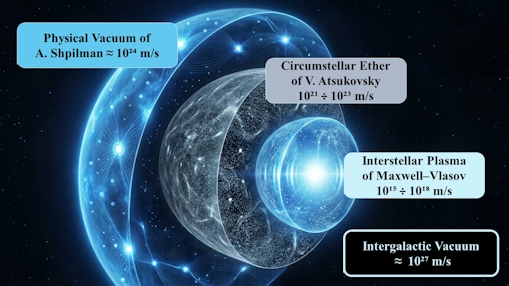
FULL COSMOLOGICAL PICTURE OF PHYSICAL VACUUM
AND
THE LONGITUDINAL WAVE WITHIN IT
Engineering
design of faster-than-light communication receives a rigorous, mathematically
complete conclusion describing the end-to-end journey of a signal pulse through
the entire Cosmos:
Level
1: INTERGALACTIC VOID (IGPV)
Speed:
10²⁷ m/s - PEAK COMMUNICATION SPEED IN COSMOS
(Engine
of the expansion of the Universe)
│
▼
(Wave
enters the Milky Way, medium condenses)
Level
2: INTRA-GALACTIC VACUUM (Shpilman's PV1)
Speed:
10²⁴ m/s - CLOCK PULSE OF THE GALAXY
│
▼
(The
wave enters the gas-dynamic ether of the Milky Way)
Level
3: FREE INTERSTELLAR ETHER (Atsukovsky, upper limit)
Velocity:
10²³ m/s
│
▼
(The
wave gets trapped in the viscous cocoon of the Solar System)
Level
4: VISCOUS CIRCUMSTELLAR ETHER (Atsukovsky, lower
limit)
Velocity:
10²¹ m/s
│
▼
(The
wave impacts dense matter and the electron gas of Earth)
Level
5: MATERIAL PLASMA OF EARTH (Maxwell Vlasov)
Velocity:
10¹⁸ m/s - EARTHLY KINETIC REBOUND
│
▼
(The wave
enters the superdense plasma center of the Milky Way)
Level
6: GALACTIC NUCLEUS / SAGITTARIUS A* (Ultimate plasma density)
Velocity:
10¹⁵ m/s - GALACTIC BRAKING BUFFER (Minimum
velocity)
│
▼
(The wave
propagates in reverse order to the edge of the Milky Way and further to the
edge of the Universe)
6.
Mechanism of transverse phase relaxation and self-healing of the wavefront
If the central
part of the wavefront decelerates to 10¹⁵ m/s when passing through
the Galactic core, while its peripheral parts rush through pure vacuum at a
velocity of 10²⁴ ÷ 10²⁷ m/s, why does the wave not
tear or collapse?
The physical
justification for compensating the deceleration difference relies on three laws
of wave dynamics of superfluid vacuum:
6.1.
Diffractive self-healing and transverse pressure
gradients:
In a continual
superfluid vacuum, the wavefront is a spatially-bound pressure membrane.
As soon as the
central portion of the front emerges from the plasma cocoon of the core (3
× 10¹⁸ m) back into free vacuum, colossal transverse pressure
gradients arise between the leading edges of the wave and the lagging center.
Due to
instantaneous transverse phase velocity in MHFV, a diffractive
"closing" of the sag occurs (in accordance with the Huygens Fresnel
principle and the self-healing effect of Poisson Arago wave beams), restoring
the flatness of the front.
6.2.
Temporal and spatial scale of delay:
Diameter of the dense core: R_core ≈ 3
× 10¹⁸ m.
Transit time of the core at a velocity of 10¹⁵ m/s: Δt_core = (3 × 10¹⁸) / 10¹⁵
= 3000 seconds (~50 minutes).
Transit time of the same segment by the lateral front at a velocity of
10²⁴ m/s: Δt_edge ≈ 0.003
seconds.
Thus, the geometric depth of the
"dent" constitutes a negligible fraction of a percent relative to the
length of the standing wave of Cosmos, and the Galaxy is perceived by the front
as an ordinary phase point scatterer.
6.3.
Law of conservation of energy flux and amplitude compensation:
According to the law of
continuity for a compressible vacuum condensate:
ρ_v
× v_ph × A² = const, where A is the
amplitude of the longitudinal pressure step.
When the velocity v_ph drops in the nucleus down to 10¹⁵ m/s, the kinetic
energy converts into potential energy, the amplitude of vacuum pressure in the
nucleus sharply increases, and the wave locally densifies.
Upon exiting the nucleus, the
vacuum condensate instantly "straightens out", shooting the front
back at a velocity of 10²⁷ m/s without energy losses.
7.
CONCLUSION AND KEY DISCOVERY OF CALCULATIONS
Comparative
analysis of all considered concepts clearly demonstrates a grand physical
regularity: the velocity spread from 10¹⁵ to 10²⁷ m/s is
a sequential and consistent "shedding and gaining of inertia" by the
wavefront during interaction with matter of various hierarchy levels:
Core Plasma
(10¹⁵ m/s) > Earth Plasma (10¹⁸ m/s) > Gaseous
ether (10²¹ - 10²³ m/s) > Superfluid vacuum FV1
(10²⁴ m/s) > Intergalactic vacuum (10²⁷ m/s).
The deeper, more
elementary, and freer from baryonic "ballast" layer of the physical
medium involved in oscillation, the more insignificant the mass and inertia of
its elements are, and the more overwhelming the phase velocity of the signal
impulse propagation is.
A longitudinal
vacuum compression wave does not merely overcome the light barrier - it acts as
a global cosmological "piston" shaping the structure of standing
waves on the scale of the closed resonator of the Universe, naturally resolving
the tension of the Hubble constant.
However,
the most stunning discovery awaits us in a detailed analysis of intragalactic
models.
Despite
fundamental differences in initial velocities, physical mechanisms, and
conceptual foundations, independent mathematical calculations inevitably lead
us to one and the same fundamental order of longitudinal wave frequency:
Maxwell Vlasov Model: 491.78 Hz (derived via
electron mass m_e and charge e of the plasma layer).
Atsukovsky Model: 491.61 491.63 Hz (derived via
gas pressure P_eth and density ρ_eth
of the circumsolar ether).
Shpilman Model: 491.64 Hz (derived via wave impedance Z₀
and permittivity ε₀ of vacuum).
A fantastic
coincidence of frequencies down to tenths of a Hertz across three absolutely
independent mathematical foundations is not a random play of numbers, but proof
of the unity of the physical vacuum.
The range of
491.63 491.78 Hz is not an abstract parameter, but the fundamental carrier
resonant frequency of our Galaxy.
It is precisely at
this carrier frequency that the vacuum of the Milky Way responds with minimal
wave impedance, opening a direct path to calculations and engineering design of
transceiver systems for faster-than-light communication of the future.
A
remarkable observation: If we take the galactic resonance of
491.63 491.78 Hz as the note B in traditional 12-tone equal temperament, then
the reference note A harmonically falls right on the frequency of 438 Hz.
Mathematical
calculation of the transition from the note B to the note A down by an interval
of 2 semitones is calculated using the formula:
f_A = f_B / 2^(2/12) = f_B / 1.12246
For the lower boundary of the
galactic range (491.63 Hz): f_A = 491.63 Hz
/ 1.12246 ≈ 437.99 Hz ≈ 438.0 Hz
For the upper boundary of the
galactic range (491.78 Hz): f_A = 491.78
Hz / 1.12246 ≈ 438.12 Hz ≈ 438.1 Hz
Thus: f_B
(491.63 491.78 Hz) → f_A (438.0 438.1 Hz)
Surprisingly, this
is precisely that very ancient physical "London standard" of the 18th
century of Henry Wood and the academic acoustic laboratories of the 19th
century (438 Hz).
Musicians and
master acousticians of the 18th 19th centuries in England, Germany, and Italy,
possessing heightened sensitivity to harmony, did not merely guess this
parameter, but, being inside the carrier longitudinal wave of the medium,
subconsciously sensed the very point where mechanical vibrations of instruments
and the physical vacuum enter into ideal resonance without overstraining the
material.
Currently, due
to unification and simplification of manufacturing for most instruments
worldwide, the international standard A = 440 Hz has been officially adopted.
At the same
time, if one looks at actual performance practice, the situation is distributed
as follows:
Lovers
of acoustic harmony and chamber music:
Frequencies
below 440.0 Hz (including 438.0 Hz) are today actively used by historically
informed musicians, acoustic duos, and chamber ensembles playing on period gut
strings and wooden wind instruments. At A4 = 438.0 Hz, string tension is
weaker, the body resonates more deeply, and the sound turns out softer and more
balanced for human perception.
Symphony
orchestras: Large modern symphonic orchestras go in the opposite
direction - they, on the contrary, tune slightly higher (441.0 443.0 Hz in the
USA, and in Germany and Austria - up to 444.0 445.0 Hz).
This is done for
the sake of a brighter, "more piercing," and more aggressive sound of
the string section in huge modern concert halls.
Regardless of
everything, the frequency f_A = 438.0 Hz, born from
the carrier resonant frequency of our Galaxy f_B
(491.63 491.78 Hz), remains that very golden balance to which creative
musicians intuitively return-those seeking not an artificial brightness and
loudness of halls, but a soft, natural resonant harmony with the surrounding
space and the Universe.
REFERENCES
1.
Shpilman A.A. What is dualism https://spinfield.kz/ALMANACH/N5_95/N_1.htm
2.
Tamm I.E., Landau L.D. Classical electrodynamics: Maxwell's equations,
Lienard Wiechert potentials, near-field physics.
3.
Vlasov A.A. Theory of vibrational properties of an electron gas and
plasma physics (Vlasov Maxwell equations).
4.
Atsukovsky V.A. General
Etherdynamics , Moscow, Energoatomizdat,
1990
5.
Landau L.D., Lifshitz E.M. Theoretical Physics. Vol. II. The Classical
Theory of Fields. M.: Nauka. (wave equations, boundary
conditions of spherical resonators, and vacuum pressure invariants).
6.
Landau L.D., Lifshitz E.M. Theoretical Physics. Vol. VI. Fluid
Mechanics. - M.: Nauka. (diffractive self-healing of the
wavefront, transverse pressure gradients, and viscous drag in dense plasma
media).
7.
Mezger P.G., Duschl W.J., Zylka R. Galactic Center: Structures and
Physical Processes. Astronomy and Astrophysics Review, Vol. 7, pp. 289-388
(1996). (distribution and concentration of ionized gas n_e
≈ 10⁸ m⁻³ in the central molecular ring and bulge of the
Milky Way in the vicinity of Sagittarius A).
8. Born M., Wolf E. Principles of Optics.
M.: Nauka, 1973. 720 p. (For Section 6.1: Fresnel diffraction theory, Huygens
Fresnel principle, diffraction on a sphere, and the Poisson Arago effect during
phase front self-healing).